The Bavarian Environment Agency (LfU) is the central authority for environmental protection and nature conservation, geology and water resources management. It gathers and evaluates data concerning the state of the environment in Bavaria. It develops objectives, strategies and plans for sustainable utilization and safeguarding of our environment. The LfU is an authority in the business division of the Bavarian State Ministry of the Environment and Public Health.

The Bavarian Environment Agency operates 31 automatic measurement stations throughout the state to continousely monitor radioactivity. The stations measure both radiation and radioactive particals in the air. The data is analysed centraly at the Agency's offices in Augsburg and is available online on the internet. The main objective is to warn the public in case radioactive material is released to the environment.
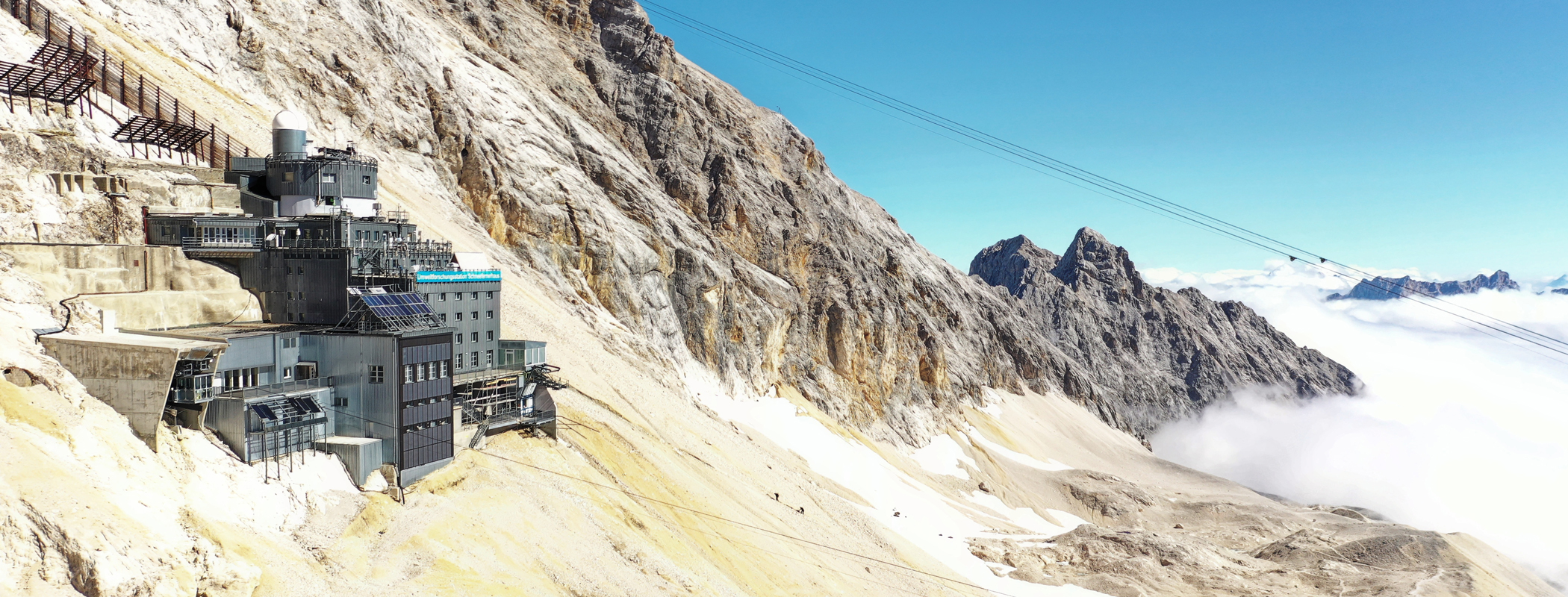
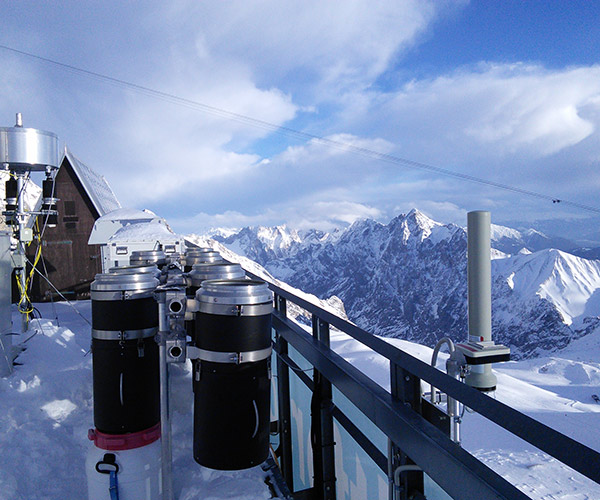
The instruments at the Environmental Research Station Schneefernerhaus are particulary useful to detect radioactive plumes reaching the country from abroad through long range transport in higher air masses.
The seismological branch of the Munich Earth Observatory (MEO) observes the world wide earthquake activity and is part of the German Regional Seismic Network (GRSN). The seismic station installed at Schneefernerhaus is also part of a network of 21 digital seismic stations called BayernNetz designed for monitoring the seismic activity in Bavaria and neighboring areas (http://www.erdbeben-in-bayern.de).
Seismological data (phase arrivals, amplitudes, periods, magnitudes and intensities) of local, regional and teleseismic earthquakes are sent regularly to international agencies (NEIS - Denver/USA; EMSC - Bruyeres le Chatel/F; ISC - Newbury/GB).
The focus of the scientific research at UFS Schneefernerhaus is on topographic effects which may be studied by comparing data from Schneefernerhaus (2650 masl) with data from the nearby station in Partenkirchen (760 masl).
Soil or rock that is permanently frozen throughout the year is called permafrost. At high altitudes in the Alps, for example on the Zugspitze Mountain, permafrost occurs in the rock fissures. Global warming, however, would cause slow thawing. Consequences could be settlement, block fall or rock fall. The Zugspitze Mountain was chosen as a representative location in the northern Alps for monitoring changes in permafrost. In 2007 a borehole was drilled through the summit ridge, commissioned by the Bavarian Environment Agency. Along this 44 m long borehole 25 temperature sensors were installed. These will collect temperature data for at least the next 15 years. The results contribute to a permafrost monitoring network for all of the Alps.
The Landesamt für Umwelt is responsible for the content of this page.
Most recently modified: April 2011